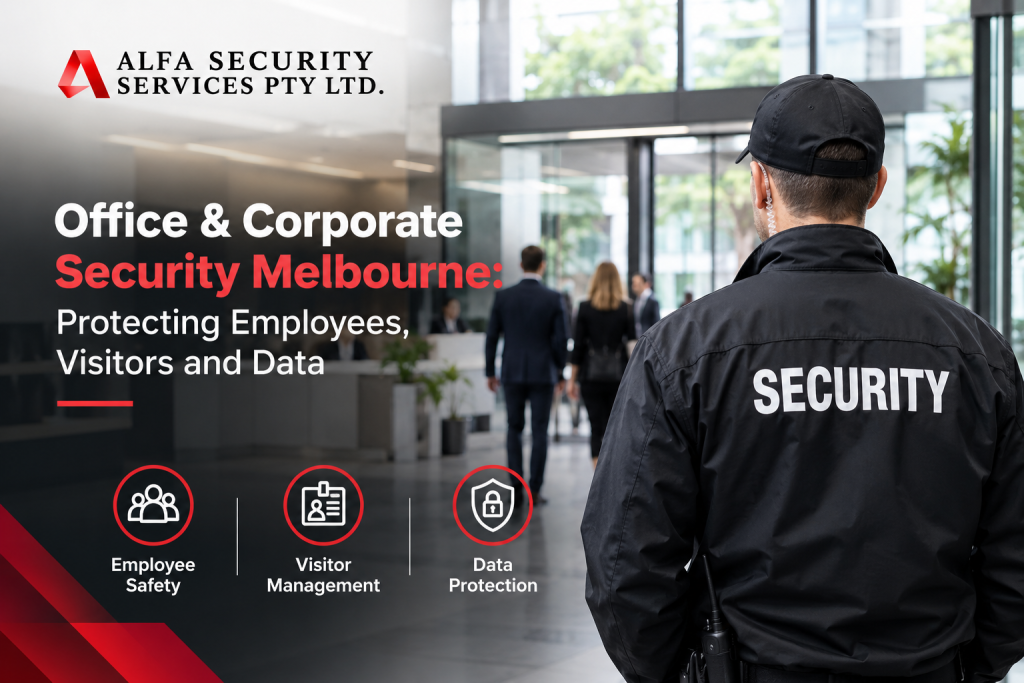
Objective
Our aim is to explain practical ways to improve office security while protecting employees, visitors, business assets and sensitive information.
Key Takeaways
- Review your main entry points and restricted areas.
- Make visitor management a clear daily process.
- Give employees simple security procedures.
- Use access control, CCTV and trained security staff where appropriate.
- Review after-hours risks and incident response regularly.
Introduction
A secure office is not only about stopping theft. It is about making sure your employees feel safe, visitors are properly managed, restricted areas stay controlled, and sensitive business information is not left open to the wrong person.
For a Melbourne business, how to improve office security starts with looking at what happens every day. Who enters your building? Who can access private areas? What happens when someone works late? What would your team do if an incident occurred?
Here’s the thing: good security should support normal work rather than make it harder.
What Does Office & Corporate Security Mean?
Office and corporate security is the combination of people, procedures and physical security measures used to protect a workplace.
It can include access control, reception security, visitor management, mobile patrols, CCTV monitoring, alarm response and security guards.
For example, Alfa Security lists access control, reception security and internal patrols as part of its corporate and office security services in Melbourne. Its service also includes surveillance technology and emergency response support.
Why does this matter?
A modern office can contain client records, laptops, financial documents, medical information, equipment and other valuable assets. A security plan needs to consider all of them.
How to Improve Office Security: Start With the Basics
Before adding new technology or security staff, review the way your workplace operates.
1. Check who can enter
Look at your main doors, staff entrances, loading areas and restricted rooms. Ask whether access is limited to people who actually need it.
2. Manage visitors properly
Your reception team should know who is expected, who they are visiting and where they are allowed to go.
A simple process can be:
Identify → Register → Confirm host → Direct visitor → Record departure
3. Review after-hours access
Safe Work Australia recommends considering risks linked to working alone, contact with the public and working after hours when assessing workplace violence and aggression.
This matters for law firms, financial services companies, medical practices, technology businesses and digital marketing teams that may work beyond normal office hours.
Practical Office Security Tips for Employees
Security is not only the responsibility of management or security officers. Your staff also play an important role.
Useful office security tips include:
- Do not allow unknown people to follow you through controlled doors.
- Report lost access cards quickly.
- Keep confidential paperwork away from public areas.
- Lock computers when leaving your desk.
- Report unusual behaviour to the right person.
- Know what to do during an emergency.
For a digital marketing team, this can be especially useful when employees handle client information, campaign data and business documents from a shared office.
How Physical Security Helps Protect Business Data
Data protection is not only a technology issue.
The Office of the Australian Information Commissioner says organisations covered by the Australian Privacy Principles must take reasonable steps to protect personal information from misuse, loss and unauthorised access. Its current guidance includes physical security and access security as part of those measures.
That means physical access to areas containing computers, servers, paper records and other information assets matters too.
Office Risk | Practical Control |
Unauthorised entry | Access control |
Unknown visitors | Reception and visitor management |
Restricted rooms | Controlled access |
After-hours activity | CCTV and patrols |
Security incidents | Trained security personnel |
Sensitive records | Physical access controls |
Physical security does not replace cybersecurity. The two address different risks and should work alongside your wider privacy and information security procedures.
Managing Corporate Security Risks
Your corporate security risks will depend on your building, staff, location, operating hours and type of work.
Start by asking:
- Where are our weakest entry points?
- Which areas should visitors never enter alone?
- What happens when the office is open after hours?
- Who responds to an alarm or security incident?
- How quickly can we review what happened?
Safe Work Australia recommends identifying hazards, assessing risks, putting controls in place and reviewing those controls regularly.
This gives you a practical process instead of relying on assumptions.
A Simple Melbourne Office Example
Imagine a corporate office with a reception desk, 100 employees, several meeting rooms and a restricted IT room.
A visitor arrives while reception is busy. An employee holds the door open, and the visitor walks inside without registering.
Nothing may happen. But the process has failed.
A stronger approach could combine controlled entry, visitor registration, CCTV coverage and clear staff procedures. If the workplace has higher security needs, professional reception staff, internal patrols or other on-site measures may also be appropriate.
The goal is simple: authorised people should be able to work normally, while unusual access should be noticed quickly.
Build Your Security Plan Around Your Workplace
There is no single security setup that suits every business.
When deciding how to improve office security, review:
- Your building layout
- Employee numbers
- Visitor volume
- Operating hours
- Restricted areas
- Valuable equipment
- Sensitive information
- Previous incidents
- Emergency procedures
Professional security services can then be considered where your assessment shows a need. Alfa Security provides corporate and office security services including licensed security personnel, access control, reception security, internal patrols and surveillance support in Melbourne.
Protect Your People Before a Security Problem Becomes an Incident
Good office security starts with simple questions and practical controls. When you know where the risks are, you can decide where access control, visitor management, surveillance or trained security personnel can provide useful support.
If you are reviewing how to improve office security, speak with Alfa Security about your workplace requirements and the security measures that may suit your Melbourne premises.
FAQ
Frequently asked questions
Start by reviewing entry points, visitor procedures, restricted areas and after-hours activity. Then match suitable security controls to the risks you identify.
Common risks can include unauthorised entry, uncontrolled visitors, theft, workplace violence or aggression, after-hours activity and access to restricted information.
This depends on the workplace and the risks that come with that workplace. Security measures and the operating hours also affect this answer. Some businesses might need reception security, security patrols, or even security on site.
Access control enables an office to only let authorised persons enter the office and also helps in preventing employees or visitors from entering areas that they have no permissible right to.
Yes. Physical barriers such as secured access or even key cards help protect the information of a business and other sensitive business information.
300+ Service Locations
Serving Derrimut, Melbourne & Major Victorian Cities
Alfa Security Services provides professional security solutions across Melbourne and Victoria, supporting businesses, commercial properties, warehouses, industrial facilities, construction projects, offices, retail centres, and residential communities.
Our services include static security guards, mobile patrols, alarm response, CCTV monitoring, construction site security, event security, and corporate security. Every service is delivered by licensed professionals committed to protecting your people, property, and assets.