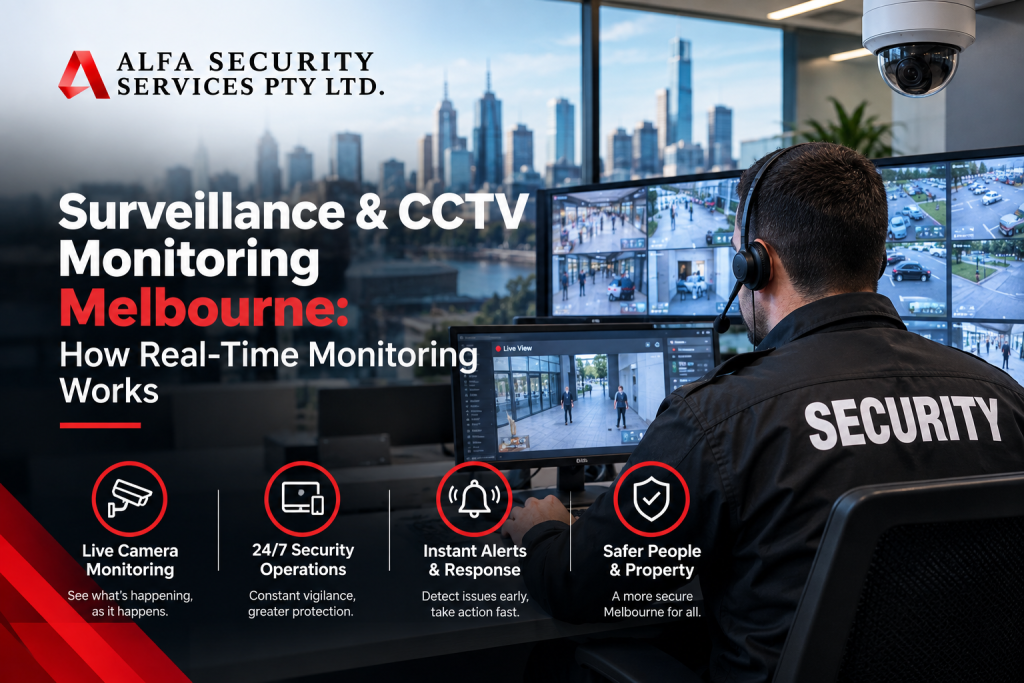
When it comes to protecting a business, property, or residential complex in Melbourne, one question comes up again and again: is it better to invest in CCTV monitoring or rely on physical security guards? The debate around CCTV monitoring vs security guards has intensified as technology has advanced, giving property owners a genuine alternative to traditional, guard-only security models. Understanding how real-time CCTV monitoring actually works — and where it outperforms (or complements) a security guard — can help you make a smarter, more cost-effective decision for your property.
What Is Real-Time CCTV Monitoring?
Real-time CCTV monitoring goes far beyond simply having cameras installed and recording footage for later review. It involves a live connection between your property’s cameras and a monitoring centre, where trained operators watch camera feeds as events unfold, ready to respond the moment something suspicious happens.
Instead of discovering a break-in the next morning by scrolling through hours of recorded footage, real-time monitoring means an alert is triggered instantly, an operator assesses the situation live, and action — whether that’s a warning through a two-way speaker, a call to police, or dispatching a mobile patrol — happens within seconds. This proactive model is a major reason businesses across Melbourne are shifting away from a “guard-only” approach.
How Does CCTV Monitoring Work?
To understand why real-time monitoring is so effective, it helps to break down the process:
1. Camera Installation and Coverage Planning
Professionally installed CCTV systems are positioned to eliminate blind spots — entry points, loading docks, car parks, perimeters, and high-value asset areas are all mapped out to ensure full coverage.
2. Motion and Analytics-Based Detection
Modern CCTV systems use video analytics — such as motion detection, line-crossing alerts, and object recognition — to distinguish between everyday activity (a cat walking past, a tree branch moving) and genuine threats (a person climbing a fence after hours).
3. Live Feed Transmission to a Monitoring Centre
When a trigger event occurs, footage is transmitted in real time to a monitoring station, where a security operator reviews the footage immediately, rather than after the fact.
4. Verification and Response
The operator verifies whether the activity is a genuine security concern. If it is, they can activate on-site audio warnings, trigger alarms, notify a mobile patrol unit, or contact police directly — all while continuing to observe the situation live.
5. Incident Documentation
Every triggered event is logged and recorded, creating a clear audit trail that’s useful for insurance claims, legal matters, or reviewing site security performance over time.
This end-to-end process is what separates basic surveillance cameras from a true real-time monitoring solution — and it’s also where the comparison with human security guards becomes most relevant.
CCTV Monitoring vs Security Guards: The Key Differences
Coverage and Consistency
A security guard can only watch one area at a time and is subject to fatigue, distraction, and blind spots during patrols. Real-time CCTV monitoring, on the other hand, can cover multiple angles and zones simultaneously, with operators monitoring several cameras — and often several sites — at once without the physical limitations a guard faces.
Response Speed
Contrary to the assumption that a physical guard responds faster, remote monitoring operators can often react more quickly because they’re watching a live feed the instant an alert is triggered, rather than needing to physically notice an incident occurring somewhere on a large site.
Cost Efficiency
Employing 24/7 onsite security guards is one of the most expensive line items in a facility’s security budget, particularly for after-hours coverage. Real-time CCTV monitoring typically delivers round-the-clock protection at a fraction of the cost of multiple guard shifts, since one monitoring team can oversee numerous properties at once.
Deterrence Factor
Visible guards can act as a deterrent, but so can visible cameras paired with audio warning capability — many intruders are startled and flee the moment a monitoring operator speaks to them live through an on-site speaker, proving that deterrence isn’t exclusive to a physical presence.
Human Judgement
This is where a hybrid approach often wins. Guards bring physical presence and can intervene directly, which is valuable in certain high-risk environments. CCTV monitoring brings consistency, scalability, and a documented record. Many Melbourne businesses find that combining both — cameras for constant oversight and guards for physical response when needed — delivers the strongest protection.
Key Benefits of CCTV Monitoring
Understanding the benefits of CCTV monitoring helps clarify why it has become the backbone of modern commercial and residential security in Melbourne:
- 24/7 Protection — Continuous coverage without shift gaps, meal breaks, or staff shortages.
- Faster Incident Response — Live verification and immediate escalation reduce the window criminals have to act.
- Reduced Security Costs — Lower ongoing costs compared to maintaining a full roster of onsite guards.
- Scalability — Easily extend monitoring across multiple sites, entry points, or locations without proportionally increasing costs.
- Evidence and Accountability — Recorded footage supports investigations, insurance claims, and legal proceedings.
- Remote Accessibility — Property owners and managers can check in on their site from anywhere via secure apps or portals.
- Reduced Liability — Documented monitoring and response protocols demonstrate due diligence in maintaining a safe environment.
Why Melbourne Properties Are Moving Toward Monitored CCTV Solutions
Melbourne’s mix of commercial precincts, construction sites, retail centres, and residential developments each come with distinct security challenges. Static guard patrols struggle to keep pace with large or multi-entry sites, while unmonitored CCTV systems only provide after-the-fact evidence rather than active protection. Real-time monitored CCTV closes this gap, offering the vigilance of a guard with the coverage, consistency, and cost advantages of technology.
For property owners weighing up security guards against a monitored camera system, the reality is that CCTV monitoring now offers a level of responsiveness that was once only associated with physical patrols — without the same overhead.
Final Thoughts
The choice between CCTV monitoring and security guards doesn’t have to be all-or-nothing. For many Melbourne businesses, the most effective security strategy blends real-time CCTV monitoring for constant, cost-efficient coverage with targeted guard presence where physical intervention adds real value. Understanding how real-time monitoring works — from detection through to verified response — makes it clear why more property owners are treating it as the foundation of their security setup, rather than an afterthought.
At Alfa Security, we specialise in tailored surveillance and CCTV monitoring solutions designed for Melbourne businesses, helping property owners protect their assets around the clock with real-time response capability built into every system we install.
FAQ
Frequently asked questions
It depends on the site and risk level. CCTV monitoring offers 24/7 coverage across multiple areas at a lower cost, while guards provide direct physical intervention. Many Melbourne properties combine both for maximum protection.
Cameras are linked to a live monitoring centre. When motion or an alert is triggered, an operator reviews the footage in real time and responds immediately — through audio warnings, alarms, mobile patrol dispatch, or contacting police.
Continuous coverage, faster incident response, lower ongoing costs than full-time guards, scalability across multiple sites, recorded evidence for insurance or legal use, and remote access to live feeds.
For many low-to-medium risk sites, yes — monitored CCTV can fully replace onsite guards. For higher-risk environments (large crowds, high-value assets, frequent physical altercations), a hybrid model with both monitoring and guards is usually recommended.